AI Overviews impact on SEO and what to measure
The AI Overviews impact on SEO is easier to understand when you separate organic position, answer visibility, and traffic. A page can hold its organic ranking while the search layout changes around it. A domain can receive a citation without gaining a visit. Neither observation alone explains business performance. This guide shows how to measure those layers, investigate possible click loss, and choose content actions without inventing a causal story from a chart.
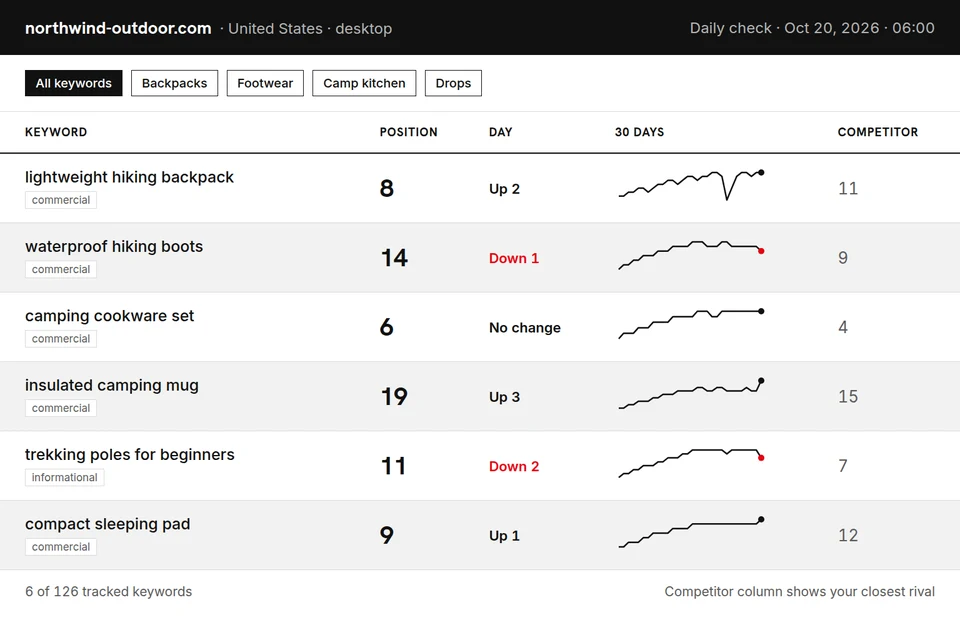
Separate organic ranking from answer visibility
An AI Overview occupies a different part of the search experience from an ordinary organic result. When it appears, a user may read the generated answer, open a cited source, continue to another result, or leave the search. An unchanged organic position therefore does not guarantee unchanged attention. The surrounding layout matters alongside the ordered list.
Record whether an AI Overview appears for each tracked query and whether it cites your domain. Preserve the organic position and ranking URL separately. This distinguishes a page losing its organic place from a page remaining in place beneath a different search feature. It also prevents a citation gain from hiding an organic decline.
Do not assume every informational query triggers an overview or every searcher sees the same layout. Availability can vary with the query and conditions. Use an AI Overview tracker to observe presence and domain citations under the recorded configuration rather than extending a single screenshot to all searches.
The same principle applies to other result features. A SERP tracker helps identify map results, snippets, videos, and other elements that also affect where a conventional listing appears on the page.
Investigate fewer clicks without assuming the cause
An answer that resolves a question on the results page can reduce the need to open a website. That is a plausible mechanism for click loss, not a universal outcome. Some queries still require comparison, detailed instructions, current product information, or a transaction. The effect depends on the task and what the visible answer provides.
When clicks decline, inspect impressions, click through rate, organic position, and result features together. A decline in impressions can reflect changing demand or reduced visibility. Stable impressions with a weaker click through rate point toward a different investigation, but they still do not prove the overview causes the change. Ads, titles, competing results, and query mix can also matter.
Use Google Search Console to inspect the affected query and page groups. Match device, country, and reporting periods as closely as the available data allows. Do not compare a fixed tracked query with an unrelated sitewide total and call the difference an AI effect.
Keep commercial outcomes in view. Fewer visits are relevant, but they do not automatically mean fewer qualified inquiries or purchases. Review the landing page journey and the outcomes your analytics can actually attribute before deciding how much business harm the traffic change represents.
Build a measurement table with distinct signals
Start with a stable keyword set grouped by intent. Record the intended URL, organic position, observed ranking URL, AI Overview presence, and domain citation status. Add clicks, impressions, and click through rate from your existing search reporting. Keep each field's source and definition clear because these systems do not measure identical populations.
| Signal | Useful question | Interpretation limit |
|---|---|---|
| Organic position | Does the listing move under fixed conditions | It does not measure every searcher's screen |
| Overview presence | Does an AI answer appear in this check | It does not establish universal exposure |
| Domain citation | Is the site cited in the observed answer | It does not establish a visit |
| Search clicks | Do visits from search change | They can reflect several causes |
| Qualified outcomes | Does valuable activity change | Attribution can be incomplete |
Keep missing observations distinct from negative observations. An unsuccessful check cannot tell you whether an overview is absent. Likewise, a citation to a different page on your domain may need separate review from a citation to the intended landing page.
The broader rank tracking software workflow helps keep these signals beside the same keyword set. Preserve their separate meanings even when a summary view makes them convenient to compare.
Compare stable groups before drawing conclusions
Define the question before choosing the chart. You might ask whether a group of informational queries loses clicks while organic positions remain similar and overviews appear more often in recorded checks. That is more precise than asking whether AI changes SEO as a whole. It also identifies which observations you need to collect.
Compare the same queries, pages, devices, and geographic scope over comparable periods. Keep branded searches separate from general discovery queries. Note changes to titles, content, page availability, and website structure. A new keyword group or a site migration can change a report independently of answer features.
A comparison group without observed overviews can provide context, but it is not automatically a controlled experiment. Those queries can differ in intent, seasonality, and audience. Describe the comparison as supporting context and explain the mismatch rather than presenting it as proof of causation.
Follow the baseline practices in how to track keyword rankings. Keep a change log, retain the original conditions, and label any collection gaps. If the evidence stays mixed, report that uncertainty and define the next check instead of forcing a confident explanation.
Read citations as source observations
A citation tells you that the observed answer points to a domain or page. It does not guarantee that the answer endorses the brand, that the linked page receives a click, or that the citation persists. Read the cited passage and its destination before treating it as a useful visibility gain.
Check whether the source supports the statement around the citation. Review whether the destination is accessible, relevant to the user's question, and suitable for the next step. A citation to an outdated help page can reveal maintenance work even when the headline visibility measure looks positive.
Keep brand mentions distinct from links. An answer can name a product without citing its website, or cite a resource without emphasizing its brand. The article on tracking brand mentions in ChatGPT explains why those fields need separate rules across AI answers.
Compare answer surfaces separately as well. A Google AI Overview citation and a ChatGPT mention answer different measurement questions. An AI visibility tool can bring them into the same workflow, but a combined total should not erase the underlying prompt, source, or observation conditions. Use the original records when explaining a change to stakeholders.
Improve the usefulness of pages you control
Use the affected queries to identify what the user still needs after reading a short answer. That might be a detailed comparison, an actionable procedure, a product specification, or a clear path to a service. Strengthen that value rather than adding generic paragraphs designed only to repeat the query.
Make important explanations direct and easy to verify. Use descriptive headings, clear terminology, and tables when they help readers compare requirements. State limitations where they matter. Keep relevant details consistent across product pages and supporting articles so a reader does not encounter conflicting descriptions of the same capability.
Check technical accessibility before treating a missing citation as a writing problem. A page with incorrect indexing directives, a broken canonical relationship, or inaccessible primary content needs technical attention. Fixing those issues supports discoverability, but it does not guarantee selection as an AI source.
- Answer the specific question before expanding into related details.
- Keep claims supported by information the business can verify.
- Remove stale guidance and contradictory product descriptions.
- Preserve a useful next step for readers who need more than a summary.
Avoid generating large amounts of repetitive content solely to chase citations. The measurement goal is to understand useful visibility, not to maximize mentions regardless of relevance.
Report what changes and choose the next action
A practical review separates observed facts from explanations. State that a query group shows fewer clicks, stable tracked organic positions, and observed overviews when that is what the records support. Then list the competing explanations and the evidence still needed. This gives decision makers a clear picture without pretending to measure individual search behavior.
Prioritize by business relevance and the strength of the finding. A commercially important page with weaker qualified outcomes may deserve earlier investigation than an informational page with fewer visits and unchanged downstream value. Do not use citation counts as a substitute for understanding the audience's task.
Assign each action an owner and an evidence requirement. A technical owner can confirm indexability. An editor can improve an incomplete comparison. An analyst can isolate the affected query group. Revisit the same conditions after the work rather than judging success from a different set of terms.
Avoid promising a click recovery or citation gain. Search layouts and generated answers remain outside your control. The useful commitment is a consistent measurement process, a documented explanation of what the evidence supports, and content improvements that help people complete their tasks.
Track the search signals behind the traffic change
SearchTracking places organic positions, search features, and recorded AI citations beside the same keyword intent. Use that context to distinguish a ranking decline from a changed results page and to investigate clicks with clearer evidence. Keep the baseline stable, preserve the observations, and make the next SEO decision around the pages and queries that matter to your business.
Check rankings