How to track keyword rankings with a repeatable method
Learning how to track keyword rankings starts with deciding what a position actually represents. A result for a mobile search in a city answers a different question from a desktop result across a country. A useful process keeps those conditions stable, records the page that appears, and connects changes to business outcomes. This guide walks through keyword selection, tracking depth, frequency, locations, devices, and the point where a spreadsheet stops being enough.
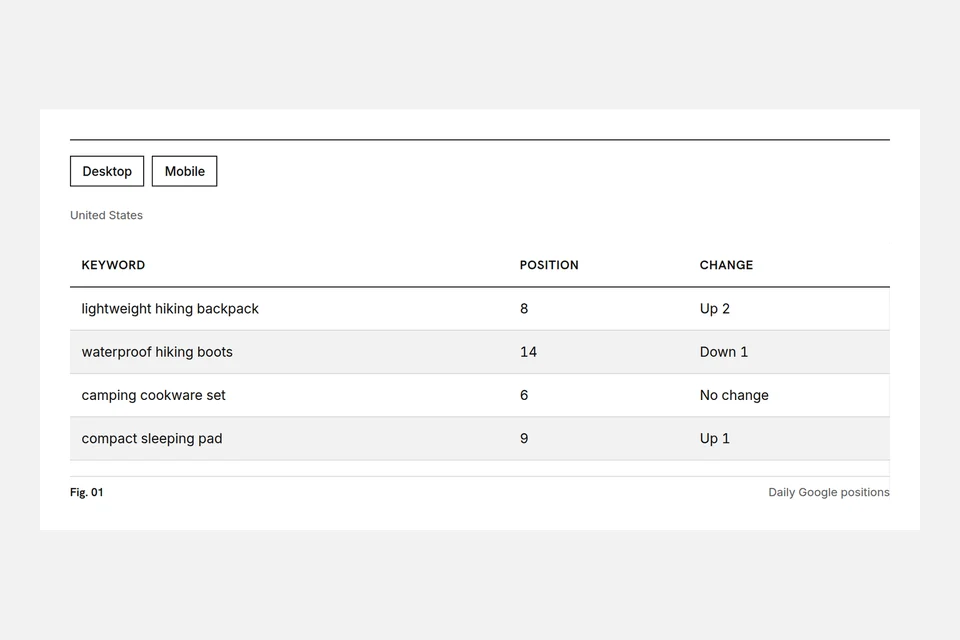
Build a keyword set around decisions
Start with the services, products, and questions your site needs to address. Map each query to an intended landing page and a reason to monitor it. A service query can support lead generation, while a troubleshooting query can reveal whether an informational resource reaches its audience. Avoid treating every phrase as equally valuable just because it has a measurable position.
Use your site's navigation, customer questions, and Google Search Console queries to build the initial list. Include brand searches, category terms, specific product needs, and informational queries. Tag them by intent and topic so a movement in one group does not disappear inside a sitewide average. Keep the original query wording rather than repeatedly simplifying it.
Record the owner of each group and what a decline would trigger. A category owner might review product availability, while an editor might inspect whether an article still answers the question. This makes the list a decision tool rather than a collection of terms.
- Assign an intended URL before interpreting performance.
- Separate brand and nonbrand queries.
- Keep a stable core set when adding new research terms.
- Archive retired queries with an explanation rather than erasing their history.
Define the conditions behind every position
Treat the query, search engine, language, location, and device as the measurement unit. Changing any of these can change the results even when the website stays the same. Write those settings into your tracking specification before the initial check. The setup described in the keyword tracker workflow helps connect a domain and keyword list to consistent conditions.
Choose locations that represent actual customers. A national publisher might need a country view, while a service business needs relevant city or ZIP views. A national average cannot establish what someone near a branch sees. Read the guide to local SEO rank tracking when geography affects eligibility or competition.
Track desktop and mobile separately when both matter to the business. Do not switch devices halfway through a trend and describe the result as a ranking change. Also distinguish a domain ranking anywhere from the intended page ranking. If an unrelated article replaces a service page, the domain position can look healthy while the search journey becomes less useful.
A manual browser search can help inspect a result, but personalization and location differences make it a poor replacement for a defined tracking configuration.
Choose a depth and preserve missing values
Tracking depth determines how far the check looks through organic results. A shallow check can show competitive terms close to the top, but it tells you less about pages gaining visibility farther down. SearchTracking checks Google positions within the top 100. That is a defined observation window, not proof that a page outside the window has no visibility anywhere.
Record a result outside the tracked range separately from a failed check. Also separate both from a query you intentionally skip. Assigning an arbitrary worst position to every missing value distorts averages and creates misleading improvement when the page returns. Keep the underlying status available in exports and client explanations.
| Observation | What it supports | What to avoid claiming |
|---|---|---|
| URL found in the tracked range | A position under the recorded conditions | The same position for every searcher |
| URL absent from the tracked range | No observed ranking within that depth | The page is removed from the index |
| Check fails | A gap in measurement | A confirmed ranking loss |
Organic depth also differs from visual prominence. Ads, map results, and AI answers can push a high organic result farther down the screen. A SERP tracker adds context about the features surrounding a listing.
Separate collection frequency from review frequency
Daily collection preserves changes that a weekly snapshot can miss. It is useful around content releases, technical changes, and volatile query groups. Daily collection does not require a daily strategy change. Review urgent exceptions when they appear, examine groups regularly, and reserve broader decisions for patterns that persist across comparable checks.
Choose alert rules around business importance and meaningful thresholds. An alert for every small movement creates noise, especially for queries with changing result layouts. Prioritize a valuable landing page leaving a useful range, an intended URL being replaced, or a cluster declining together. Confirm the observation before assigning a cause.
Keep a change log beside the history. Record when redirects, navigation changes, content revisions, or indexing directives change. An annotation gives you a hypothesis to investigate. It does not establish that the nearest website edit causes the nearest ranking movement.
Avoid taking repeated manual checks until one matches the result you expect. That selects evidence after seeing the outcome. If a result looks unusual, preserve it, check the settings, inspect the search page, and compare the next scheduled observation before rewriting the narrative.
Know when spreadsheets help and when tools help
A spreadsheet is useful for a compact audit, a fixed research task, or a review sheet that combines observations from different sources. Its strength is transparency. You can show exactly which query, conditions, URL, status, and decision each row contains. Its weakness appears when manual collection becomes inconsistent or consumes the time intended for analysis.
Create columns for query, intent, intended URL, observed URL, location, device, position, result status, and notes. Keep observation timing in the working record so you can compare equivalent periods. Use separate rows for distinct conditions rather than overwriting a desktop position with a mobile position. Protect historical records from accidental edits.
Automated rank tracking software helps when you need scheduled collection, retained history, segmentation, and alerts across a growing list. Continue to export or document the settings so the process stays understandable. A tool does not compensate for a keyword set that has no connection to business decisions.
Compare rank tracking tools against the locations, projects, reporting needs, and AI check allowance your workflow requires. Do not choose solely by how many keywords fit if the required device or geographic view is missing.
Turn movement into a testable explanation
When positions decline, narrow the affected segment before changing pages. Ask whether the movement affects a topic, a directory, a device, a location, or the whole site. Check whether the ranking URL changes. A sitewide pattern suggests a different investigation from a single article losing relevance to a changing query.
Inspect indexing, canonical selection, redirects, and page availability when a URL disappears. For a page that remains indexed, compare its purpose with the pages currently appearing. Search intent can shift toward local services, product listings, or instructional content. Adding more text to the wrong page type may leave the central problem untouched.
Use clicks, impressions, and click through rate from Google Search Console as context. Its average position aggregates observations under its own methodology, so it need not equal a fixed tracker position. Compare matching query groups and devices instead of forcing the figures to agree.
The guide to mobile vs desktop rankings explains how to isolate a device gap. Keep technical issues, result layout changes, and changing demand as separate hypotheses until the available evidence supports a connection.
Keep the baseline useful as the site changes
Build each review around an observation, its business relevance, and the next action. A ranking chart alone leaves readers to guess whether movement matters. State which queries and conditions change, which landing pages are affected, and whether clicks or qualified actions move in the same direction. A stable ranking with weaker clicks deserves attention too.
Maintain separate views for the stable core set and the complete current set. Adding difficult queries can lower an average even when existing queries hold their positions. Explain changes to list composition, locations, and device coverage before comparing reporting periods. Preserve the earlier configuration when you need a defensible historical comparison.
Assign an owner to each follow-up and define what evidence resolves it. That might mean confirming a redirect, comparing an intended page against the current result type, or checking whether a decline persists. Avoid promising that a position returns by a deadline.
Keep ranking changes distinct from AI mention changes. They describe different search surfaces and need different denominators. A useful review connects them to the same customer need while retaining the original observations behind each conclusion.
Put a consistent tracking process into practice
SearchTracking brings daily Google positions, ranking URLs, devices, locations, and AI visibility into the same workflow. Start with a focused keyword set and clear measurement conditions, then use the history to decide what deserves investigation. Consistent collection gives your next content or technical decision a clearer foundation than an isolated browser search.
Check rankings